ABOUT
Sonia Kaur Sambhi
Yoga & Somatic Practitioner • Community Care Organiser • Facilitator
MY APPROACH
Hello sweet friend! I’m delighted you landed here.
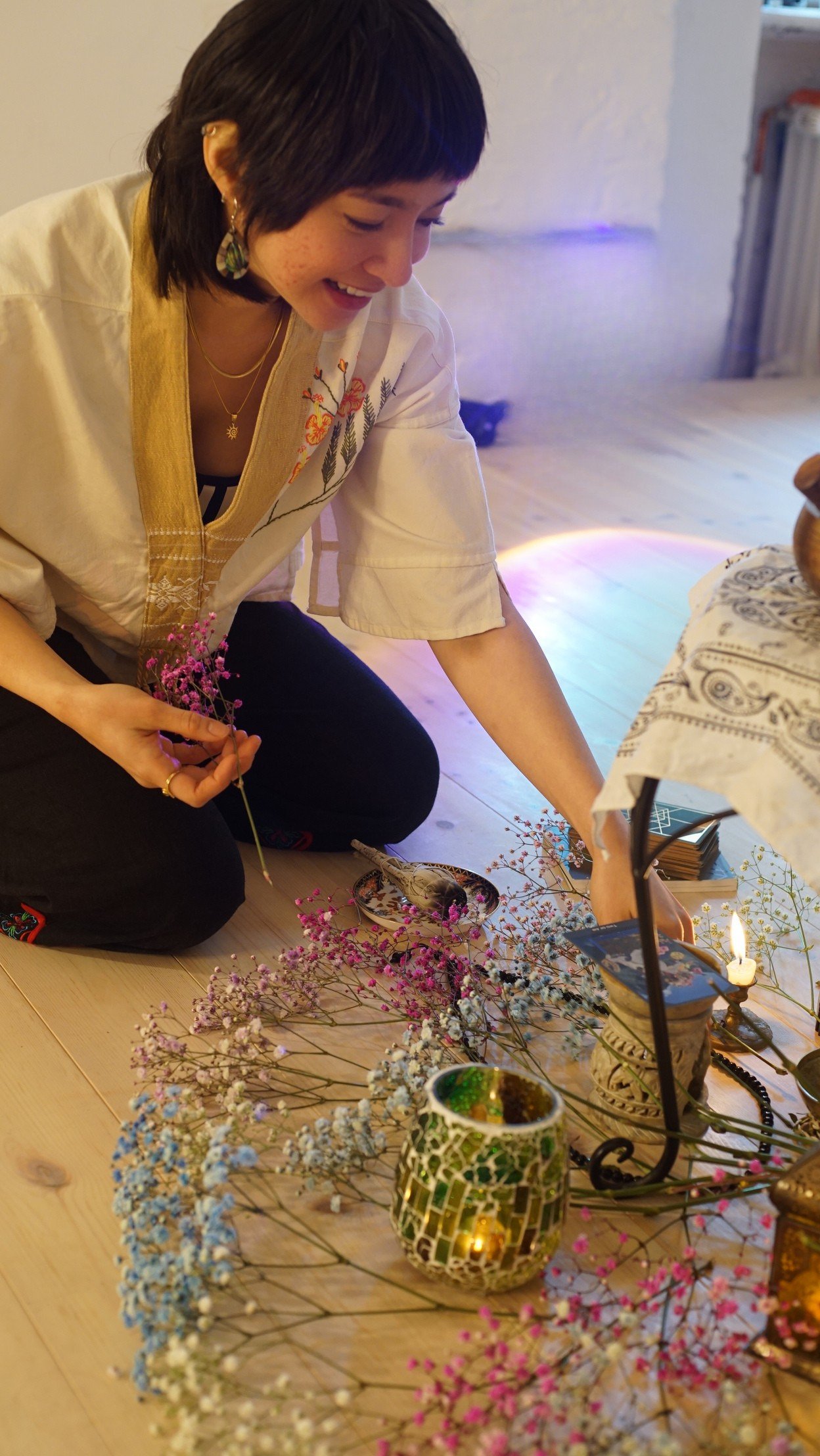
I am a genderqueer Punjabi-Chinese yoga & somatic practitioner, facilitator, and community care organiser whose work is guided by Love.
Everything I offer begins with the belief that the body is both a site of memory and a site of possibility — a place where we can return to ourselves with tenderness.
My approach to healing is trauma-sensitive, slow, and rooted in collective liberation. It is shaped by collaboration with the Earth, ancestors, and the many teachers, both human and non-human, who continue to guide me.
I work at the intersection of somatic inquiry, healing and ritual. I believe that relationships — to oneself, loved ones, water, the Land, the moon, the tree outside your window — are the bedrock of our lives. Everything I do begins with this simple truth: we heal in relationship, not in isolation.
My practice is deeply inspired by queer feminist movements, energy work, and the power of relational care.
These threads weave together in my facilitation: a blend of somatic inquiry, breath, gentle movement, intuitive touch where needed, and a commitment to meeting people exactly where they are.
ACCREDITATIONS & CERTIFICATIONS
-
This is part of the professional training as Somatic Movement Educator and includes methodologies such as Continuum, Feldenkrais Method, Middendorf's Breath Experience, Body-Mind Centering®, experiential anatomy, Authentic Movement and Somatic Yoga.
-
The Usui Reiki Ryoho Training Programme includes:
What Reiki is, how it works & how to activate the energy
The principles, ethics & benefits of Reiki
The history of Usui Reiki Ryoho
How to give treatments to yourself & others
Sensitizing your ability to sense energies and recognize & work with imbalances
Understanding & balancing the chakras
Energy protection, cleansing & grounding rituals
Led by Nina Kim, Reiki Master, CMT.
-
This training is designed for practitioners and educators, offering a unified somatic approach to trauma-informed care: including a deeper understanding of the body’s relationship with social, environmental, developmental, relational, spiritual, and cultural wounding and healing.
-
This training program brings a plethora of essential pillars — Yoga philosophy, functional anatomy, sequencing, asana modifications and Ayurveda, all of which we studied within a framework of daily pranayama, asana and meditation practice.
Led by Leigh Khoo, E-RYT 500 & YACEP Registered Teacher.
My learning is guided by ongoing questions around care, belonging, embodiment, and collective healing. The trainings I’ve been part of have supported me in exploring these questions, and I share them as part of my living inquiry.
Some questions guiding my work are:
How do we return to the body within systems that encourage disconnection, urgency, and fragmentation?
How do we create spaces where dignity, safety, and belonging can be re-woven together?
How do we stay rooted below while remaining open above — in relationship with both the Earth and Spirit?
What becomes possible when we reclaim the parts of ourselves that have been denied, suppressed, or made small?
How do we practice care in ways that are embodied, relational, and sustainable?
That being said, I have a complex relationship with certifications. Many of the practices I draw from come from lineages that have been extracted and institutionalised in ways that limit access. It is important to note that I don’t see certifications as the sole measure of wisdom and experience.
ABOUT TENDER VESSEL
tender vessel brings together the softness and slowness with which I approach my bodywork practice,
alongside a teaching from Reiki that deeply informs how I understand healing.
As practitioners, we are not the source of healing — we are channels through which universal life force energy moves through. The healing itself happens within your body and being.
The spaces we create together — whether one-on-one sessions, group practice, or longer containers — become the vessel that holds this process.
My role is to tend to that vessel with care: to cultivate conditions of safety, consent, and presence so your body’s own intelligence can lead.
To be a tender vessel is to honour the body as a site of memory, sensation, pain, but also one of possibility, joy and resistance — and to meet all of that with compassion.
It is an invitation to slow down, listen, and trust what unfolds when we allow ourselves to be held.
Through studying yoga, somatics, and receiving bodywork, I began to understand that the body remembers what language cannot always translate. Trauma isn’t an event; it’s a disruption and overwhelm to our body-mind’s capacity to adapt, thrive and flourish. It’s a set of impulses and contractions stored in our tissues. We cannot think our way out of what is held in the body.
Somatic work opened the door to a bottom-up approach to healing: one that starts with sensation, breath, and presence, rather than analysis. It gave me a different kind of access to myself — softer, deeper, slower, and ultimately more liberating.
HOW I CAME TO THE BODY
For years, I sought healing through talk therapy. I became articulate about my experiences, aware of my patterns and the narratives I carried. Multiple therapists reflected back that I was “self aware,” but I had reached a wall with that awareness — something still felt stuck. I kept circling the same familiar narratives, understanding them but unable to move beyond them.
It wasn’t until I entered the world of somatic and bodywork that things shifted.
LIVING WITH CHRONIC PAIN
I live with a history of chronic pain, and this has profoundly shaped my understanding of the nervous system in intimate ways.
Pain teaches me that dissociation is not a failure but a survival strategy. It teaches me that we do not need to be “regulated” all the time to be okay. Instead, what we need is flexibility, a system that can expand and contract, activate and settle, move in and out of balance with some degree of ease.
What I am actively practicing, in my own body and with the people I support, is the capacity to create enough space to hold pain with tenderness. Increasing our capacity to meet any kind of pain with curiosity and presence as much as possible, and to make choices that feel aligned even in difficult moments.
IN-BETWEENNESS
Much of my work is shaped by my in-betweenness.
I am mixed-race (Punjabi–Chinese), non-binary, and diasporic — living between cultures, identities, geographies, and ways of knowing.
I know what it is to move through the world without a single place to fully land, and what it takes to build belonging from the ground up.
This in-between space has taught me how to listen closely, how to hold complexity, and how to create containers that do not demand coherence or certainty. It informs my commitment to non-binary ways of being in the body — beyond rigid categories of right/wrong, healed/unhealed, regulated/dysregulated.
I am drawn to practices that make room for contradiction, fluidity, and becoming. Spaces where tenderness is not weakness, and where care is not conditional on productivity or legibility. My work invites people — especially those who live at the margins or between worlds — to find permission to exist as they are, and to build belonging together.
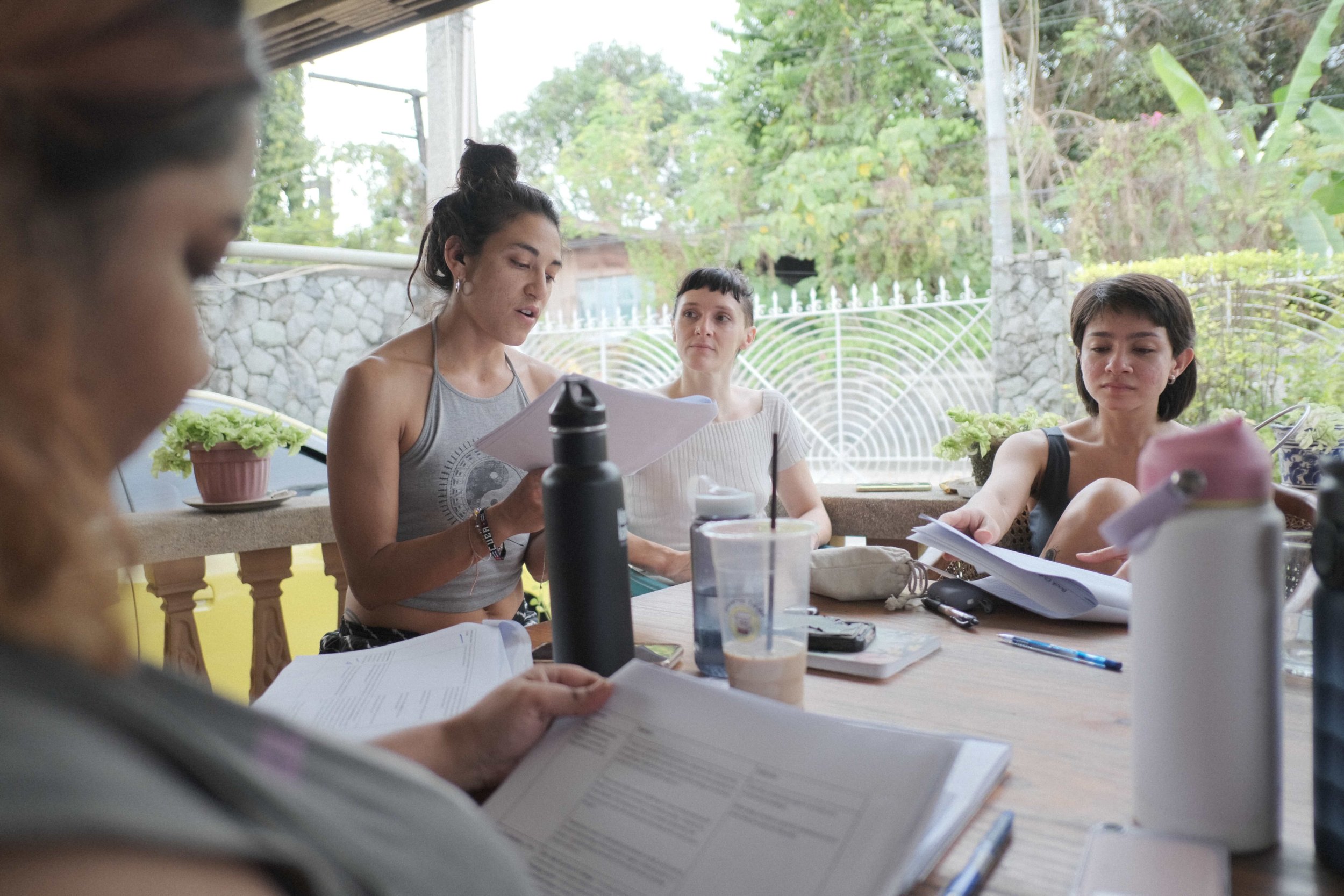
My work has been shaped through relationships with teachers, organisers, healing practitioners, artists, comrades, friends, and communities across many places and seasons of life. I am especially guided by queer feminist movements, abolitionist frameworks, somatic and spiritual practices, and traditions that understand the body as inseparable from land, ancestry, and community.
Some of the people and lineages that continue to guide my practice include Leigh Khoo, Yoke Wen Lee, Elisabeth Yupanqui Werner, Shirin Eghtessadi, Audre Lorde, bell hooks, Thich Nhat Hanh, adrienne maree brown, Lama Rod Owens, Susanna Barkataki, Nkem Ndefo, Nina Kim, and my witchy grandmother, Balbir Kaur.
I also hold deep gratitude for the communities and collectives that have shaped how I understand care, belonging, and collective practice — including Your Head Lah!, Collective Wellness, Emerging Islands, ALPAS Filipinas, and Binsi Thailand.
This work continues to evolve through practice, collaboration, friendship, and the ongoing process of learning how to be in right relationship with ourselves, each other, and the living world.
LINEAGES & COMMUNITIES THAT SHAPE MY WORK